Showing posts with label astronomy. Show all posts

Sunday, June 25, 2017

More Aurora and Night Sky Pics from the South Pole!

A few weeks ago I mentioned that I was going to try to get into a little night sky and aurora photography while down here at the South Pole. This was largely inspired by my friends and colleagues Martin and Robert who have done some amazing photography down here.  Well, really, it was inspired by them and my mom who kept bugging me to get my own pics.  In fairness it is nice to finally have a few of my own... So, I guess thanks Mom!  There are also a handful of others who are also taking some amazing pics, and hopefully in a future post I can link to some of their work as well.  In the mean time, I have put together a quick blog post with a few of my pics from a couple days ago. I went out to get a some photos of the Milky Way and the Large Magellanic Cloud, mostly because at the time it was finally clear and there weren't even any noticeable auroras out. I was actually talking to another person on station, Hunter who is another of our great photographers, and until recently he has been trying to get pictures of the Milky Way, but for him the aurora kept getting in the way!  I am a little less picky and don't mind the aurora, but thought I would take advantage of the clear skies to get in a few more traditional night sky shots.  It took me a few tries to really get the images I was trying to get, as you will see if you look at the full album linked to below.  Eventually, however, I got a few really good photos of the Milky Way and the Small and Large Magellanic Clouds.

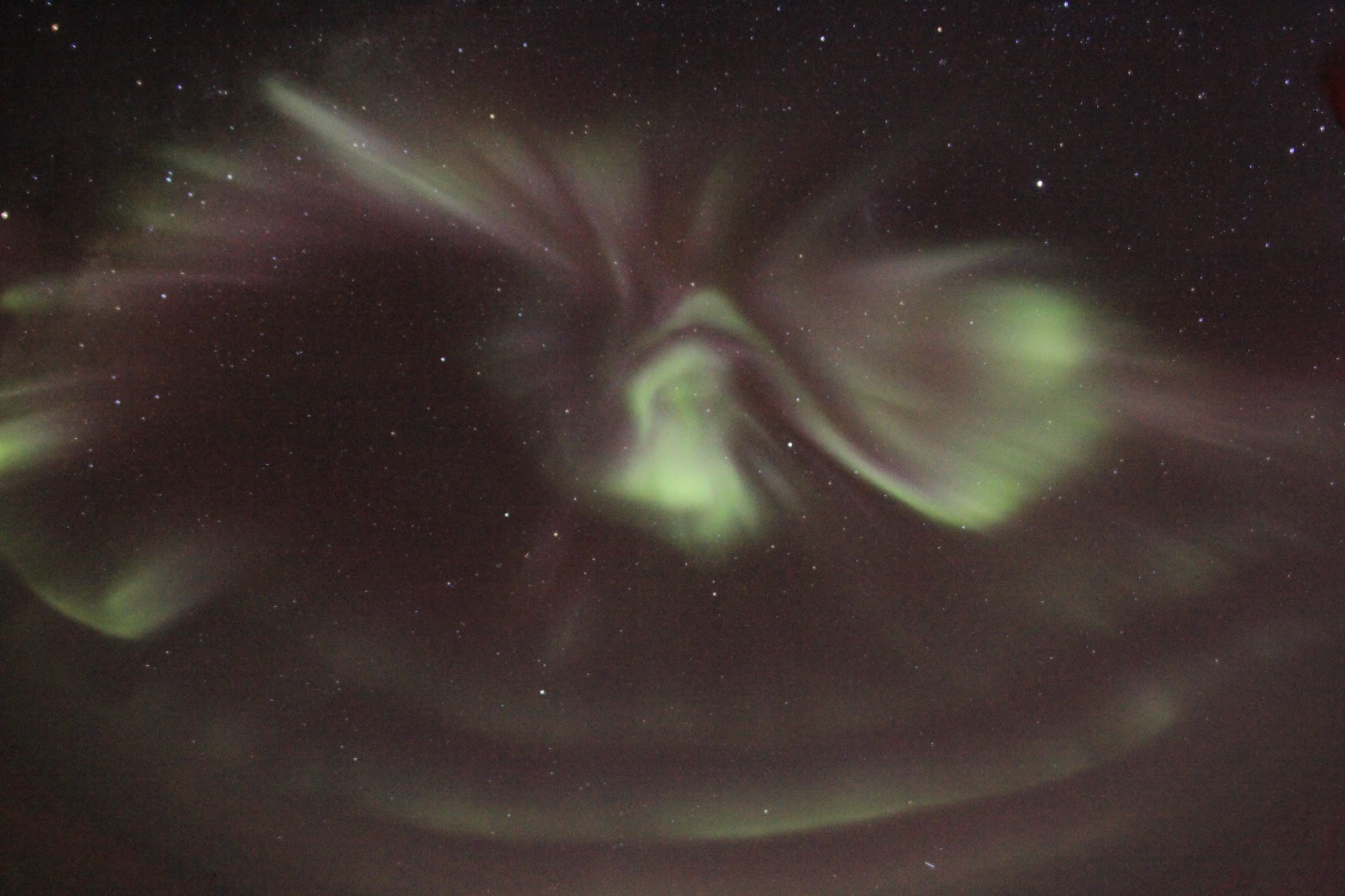
As it turns out, however, you can't go very long without those "pesky" auroras showing back up down here! After taking a few of the more traditional pictures, I ended up getting a ton of aurora shots.  It was actually surprising how bright some of the aurora were after it had been so clear! They were also very dynamic, so I was able to get a ton of different shots all within a relatively short amount of time. I am still experimenting with the photography so that is why some pictures are brighter than others.  I also don't do any post-editing which could bring out some of the colors a little better. I might do this in the future, but for now, the pictures are a little more raw.

The photos below are a small selection of the full set with a little bit of commentary.  The full album is located at  https://goo.gl/photos/rCrTdSzRFdYtV8Xy8.
 

The Milky Way with the Large Magellanic Cloud in the upper left corner!


The Large Magellanic Cloud (center-ish) and the Small Magellanic Cloud (upper-left-ish).


Me, auroras, and the Milky Way!


I really like the structure of this one.


This one looks like a bird to me... maybe a phoenix!


Aurora under the Milky way!


The flag line leading to the dark sector is lit up with auroras!

Thursday, May 25, 2017

Aurora and time lapse photography from the South Pole!

The past couple of weeks have been busy and exciting here at the South Pole.  There has been a great deal of activity with the detector, but also, the moon has set, which means that the aurora are visible again. The moon is so bright that when it is up it obscures all but the brightest of aurora and even those aren't as exciting when you try to view them under a full moon.  Now that the moon has set and it has gotten dark, many of the photographers on station have broken out their cameras again and there will be more photos flooding their various social media accounts!

Before we get into the aurora, it is worth noting that IceCube had some big happenings last week. We generally run our detector configuration a year at a time.  It's not that there is a big difference from one year to the next most of the time, but it is a way we can break our data and filtering up into more manageable segments.  Most of our offline analyses are actually done a year at a time or with collections of "years" of data.  Last week, we transitioned from our 2016 physics run to our 2017 physics run.  This marks another year of successful data collection by the IceCube Neutrino Observatory! Martin and I assisted some of the scientists and technicians in the North in the transition.  This process involves updating some software on the detector, and in this case, we actually retired an older system in favor of a newer and hopefully more robust one. Overall the transition went well, and we are excited to be starting another year of particle astrophysics research with one of the greatest experiments ever built... not that I am in any way biased or anything!

Not only do I get to work on such an amazing experiment, but I am also very happy to say that I get to live an amazing environment.  Mostly, I don't spend a great deal of time outside, but when I do, there are times that I am treated to one of the most amazing light shows I have ever seen.  Martin and I had to do some repairs the other day out at the IceCube Lab.  Just as a reminder, this is a 3/4 of mile walk away in temperatures that lately range from around -70F to -80F with wind chills well below -100F.  While out there, Martin set up his camera to do a short time lapse (available soon for the public?).  He got some amazing shots, including one of the stills below.  After we had finished our work, we headed back, but the aurora were so amazing, we stopped several times to admire them.  Martin even tried to get a few more shots in before his camera froze. I have included one below that he took of me in front of the aurora.  For those interested in more of his photography, here again is a link to his flikr account:

https://www.flickr.com/photos/135762220@N06

Here in the near future, I think I am going to try my hand at a little bit of aurora photography. I don't know that I will be able to get anywhere near as good as Martin is, but maybe I can get a few good shots in here or there.

Besides Martin, there are also a few other people on station who have gone out several times to get aurora shots.  One in particular is Robert Schwarz.  Robert has spent more time at the South Pole than any other person ever.  He is currently working on his 13th winter at pole, and is planning to come back next year for one more winter.  Over the years, he has developed a skill at photographing aurora this includes a great deal of time lapse photography as well. He has a few websites with many pictures and his time lapses posted. I encourage you to check them out.

http://www.antarctic-adventures.de
http://www.facebook.com/southpoleskies
http://www.vimeo.com/polarlights

Between Martin and Robert and several of the others who I will try to link to in the future, we have an amazing group of photographers down here! They have done an amazing job of capturing the beauty that we get to see down here on a fairly regular basis, barring light pollution from the moon!

Other than that, things have mostly been going as usual. I am still working on learning French, and I think I am about to start on Russian. I have been practicing more on the violin, and I am starting to think about trying to memorize a few specific pieces I have been working on. I was trying to read a science paper a day, but that has slowed down a bit over the past week.  I am hoping to get a little more focused on that over the next week or so and maybe do some extra reading to get caught up. That being said, I am sure I know why you are all really reading this blog, so here are the pictures!


Martin snapped this picture of me (James) in front of some aurora and the South Pole Telescope (SPT) on our way back from fixing hardware problems at the ICL - Martin Wolf IceCube/NSF

Martin laying down in front of the ceremonial South Pole and the station, looking at the stars and aurora - Martin Wolf IceCube/NSF

Martin standing in front of the station with aurora in the background - Martin Wolf IceCube/NSF

Aurora over the South Pole Telescope (SPT) - Martin Wolf IceCube/NSF

Aurora over the station - Martin Wolf IceCube/NSF

Aurora over the station observation deck - Martin Wolf IceCube/NSF

The IceCube Lab in the starlight - Martin Wolf IceCube/NSF

The moon over the South Pole station - Martin Wolf IceCube/NSF

Martin out in front of some aurora - Martin Wolf IceCube/NSF

Martin got this pic of our station physician assistant taking pictures of aurora... How meta!

This is a shot of our station physician watching the aurora - Martin Wolf IceCube/NSF

Another aurora shot with the Milky Way in the background - Martin Wolf IceCube/NSF

A shot of the Large Magellenic Cloud from the South Pole - Martin Wolf IceCube/NSF

Martin and James posed for a picture in front of the ICL to send to the IceCube Collaboration during their most recent meeting - Martin Wolf IceCube/NSF

16 Hour DarkSector Sky Time-Lapse at South Pole
16 Hour Dark Sector Time Lapse at the South Pole (you may need to click on this one to really see it) - Martin Wolf IceCube/NSF


Monday, May 01, 2017

Six Months at the South Pole!

Today is a very exciting day for me! It marks six months at the South Pole.  I arrived here on November 2, 2016, a few days before my last birthday, and I have been here six months as of today. It has been a wonderful adventure so far and I am looking forward to the next six months, especially now that the sun has set, and we are having some amazing views of the night sky with the stars, milky way, and especially the auroras!

Over the past few weeks, life on station has been fairly routine. The temperatures went up a bit for a while, but are now holding around -90F with a wind chill of around -130F. I generally get up every day and the first thing I do is check email and check on the experiment I am working on, the IceCube Neutrino Observatory. I then try to move on to personal projects, assuming everything is running well and no one from the IceCube group up North has any requests.  Thankfully, the detector has been running very smooth lately, and with the exception of a few small problems and some calibration work, there hasn't been much that we've had to do.  As it turns out, however,  the one "big" problem we had to deal with lately was a failed power supply a few days ago.  For some reason since winter started, I have moved more to a night schedule. Really, this doesn't make much sense, as it is always dark here since the sunset, but somehow, even without any real sense of day or night, I still moved to a night schedule.  That being said, a few days ago, I had just fallen asleep when I got a call from Martin about the power supply which failed a little after breakfast.  Thankfully, Martin was on call and it was his turn to go out and replace the power supply.  Unfortunately, when he got out there, it looked the like the problem was bigger than expected and I ended up having to go out and help. Generally, it isn't that big a deal, but now that it is has gotten colder, and since our lab is about 3/4 of a mile away from the main station, by the time I walk out there my balaclava (face mask) has frozen over making it fairly difficult to breath...  not to mention we are still at roughly 10,000 ft altitude.  Suffice it to say, that walking out to the ICL and back can wear you out! At any rate, after I got out there, Martin and I did our work which ended up taking a few hours, and then I headed back to station for lunch and to get some sleep.  Martin, however, stayed out to get some more amazing pictures.  Overall it turned out to be a pretty long day, but it was still a good day, all things considered.

For the most part, winter has been an amazing time. The last power supply failure we had before this week was a couple months ago, and beyond that, our work has mostly been the occasional calibration run. I have been thinking back some over the past few months, and I remember when I first arrived, and we spent the summer working and preparing for winter. Even then I enjoyed my time here, but since the winter season officially started mid-February with all of the summer people leaving, the station has taken on a much different atmosphere. It almost feels like a totally different place. I had heard from some of the previous winterovers how much better it is in winter, and looking back now, I definitely have to agree.  Life is much more laid back now, and our interactions are so much more personal now that we only have 46 people on station. There have obviously been a few small conflicts here and there, but in general, everyone seems to be getting along very well. The people here on station come from all walks of life and political and philosophical backgrounds, but we respect each other and have learned to live together peaceably.

As for my personal projects, I am making progress, more some days than others.  I have been practicing the violin regularly, and there are times I really enjoy it.  Other times, it takes a little motivation to get myself to practice, but in the end it seems to be worth it as I feel that I have at least improved some over the past couple months.  I have been reading a ton, mostly science papers, and I have also been working on some computer projects. I have been playing around with and reviewing some network security ideas and practices, but I have also spent some time playing around with statistics and some programming languages.  In particular, I have been trying to spend some time learning ROOT and Octave, as they have some very powerful tools for statistical analysis. There have also been a few other little computer projects here and there. I am behind on my language studies, but not irreparably so.  I haven't spent much time on Duolingo over the past week and half, but I am hoping to jump back into it in the next day or two. I have also been thinking about a few other small projects that I had planned for the winter.  I'd like to spend some time studying for my instrument rating, and I would like to spend some time really learning Morse code. As of right now, these are not high priority, but maybe I'll start working on them soon.

Overall, things are going well.  I am still very happy to be here. The past couple of weeks, I have gone outside regularly to watch the auroras and see the stars. It is kind of a surreal experience. I have never lived in a place where you could step out at any time of day and there is a chance you'll see auroras.  On that note, my friend and colleague Martin has take some amazing aurora pictures.  I am posting some of them below, particularly for those of you who have not seen them already on facebook, but please check out his flickr account (https://www.flickr.com/photos/135762220@N06) for even more!


The moon and stars from the South Pole! - Martin Wolf IceCube/NSF

Auroras over the dark sector - Martin Wolf IceCube/NSF

Martin in front of the station with an aurora in the background - Martin Wolf IceCube/NSF

The IceCube Lab with auroras in the background - Martin Wolf IceCube/NSF

Aurora and the moon from the station observation deck - Martin Wolf IceCube/NSF

The station with an aurora in the background - Martin Wolf IceCube/NSF

More auroras - Martin Wolf IceCube/NSF

Another Shot of the station with auroras - Martin Wolf IceCube/NSF

A coronal aurora from the South Pole! - Martin Wolf IceCube/NSF

One last shot of the station with auroras - Martin Wolf IceCube/NSF


Wednesday, April 12, 2017

It's getting dark at the South Pole!


The past couple of weeks at the South Pole have been really great. Our detector (The IceCube Neutrino Observatory) has been fairly stable with only a few small issues that Martin and I have had to deal with.  The most "exciting" event happened last week on early Wednesday morning when the wind picked up. It turns out that the wind was blowing some cold air into the ICL (IceCube Lab) and was causing the building temp to drop below our lower limits.  Martin and I ended up having to wake up one of the maintenance guys on site to help figure out the problem and get it all fixed again.  Thankfully, all we had to do was close a vent and then the temperatures climbed back up to a safe level.  Additionally, since we have remote access to the equipment in the building, we didn't even have to walk out in the middle of the night.  We did everything on the station which was very nice, especially at 3 or 4 in the morning!

Cold temperature warnings aside, our weather here has been all over the place.  The temperatures last week got as high as -45F.  That is far warmer than I would have expected, considering that I just heard tonight we might hit -90F by this weekend! The funny thing about that is that I am getting used to the colder temperatures here.  I actually went out for a few minutes a few nights ago onto one of the decks wearing a t-shirt, shorts, and flip-flops.  In fairness, I didn't stay out long, only a minute or two, but it is kinda funny to me that I was even able to get out for that long!  As I have mentioned in a previous posts, we had to cover all of the windows on station to prevent light from the station from interfering with some experiments here.  If we want to see what it looks like outside, we actually have to go outside.  So the other night I went out to see how things were looking. It was actually pretty amazing. I almost got a little giddy, staring up and the first few stars to be visible.  I am still so excited to be down here right now as it is getting darker and the long winter night is starting. The sun set here a few weeks ago, but it is still not completely dark. It has gotten dark enough, though, that now we are starting to see more and more stars.  In fact, last night I went out and saw the very first aurora of my life!  It was very faint and hard to see, but even still it was amazing.  I am really looking forward to the days ahead as it gets even darker and there are more stars and aurora visible.

Other than that, I have been staying busy as usually with my winter projects.  I have been teaching a ham radio class here that seems to be going well, though at times a little slower than I am used to. Normally I would teach this class in roughly 6 hours strait,  but I have spread it out over a couple of months down here.  If everything works out, and I can get things organized with the ARRL, we should be able to offer the ham radio license exams sometime next month!  I have also been doing language studies every day.  I finished going back through Spanish on Duolingo, and soon I will be trying to supplement with more external resources.  In the mean time I am still practicing French and thinking about adding Russian soon. I have been practicing the violin a few times a week, and I am enjoying that. The only area where I am a little behind is reading, but I have been making progress, just not as much as I would like.  Thankfully, I still have some time, and I am confident that it will all work out in the end.

I know it probably sounds a little cheesy, and you may be getting tired of me saying it, but I am still so happy to be here right now. I have a great job facilitating scientific research on one of the most amazing astrophysical experiments in the world.  I am about to see stars and auroras from an amazing location that few people will ever visit, much less at night. I am living and working with an amazing group of people here, and I am truly enjoying this adventure.

As it gets a little darker, I hope to add more pictures, particularly of the stars and auroras. Until then, here are a couple I took the other day.  These are probably not the greatest pictures, but hopefully, I can get some more of Martin's amazing photography soon and get those posted.


The South Pole Telescope (SPT), Bicep, and Keck at dusk.

A zoomed in view of SPT, Bicep, and Keck!

Wednesday, February 15, 2017

Closing the South Pole Station for Winter

There are basically two seasons at the South Pole, summer and winter. Summer lasts about three and a half months, and is at least a little bit warmer. The sun stays up 24 hours and doesn't set.  The temperature this season reached a high of just under 1F though it was mostly around -20F. During the summer season we have around 150 people on the station at any given time.  Most of these people are here to do upgrades and fix problems on the station or with their experiments so that they are ready for the winter.  Throughout summer, there are regular flights into and out of Pole.  Many people come in or out.  Supplies are brought in. There are even some tourists.  After the station closes for winter, that all changes.  The winter gets much colder.  The lowest temperature can go below -100F.  Sometime in March, the sun will set over the course of a couple weeks.  Then finally in April it will start to get dark giving 24 hours of night.

Yesterday was an exciting time for those of us spending the winter here at the South Pole.  We closed the station for winter.  This means that the last of the summer support people flew out, and there are no more big flights in or out of the station.  There will be a couple of smaller planes that will stop here to get fuel on their way across the continent to get home, but even those will stop coming in soon.  We are effectively on our own at this point. There are 46 people that will be spending the next eight and a half months living and working together at the Amundsen-Scott South Pole Station.  It is a very exciting experience for all of us. There have only been around 1,500 people to spend the winter at the South Pole. Interestingly, more people have summitted Everest than have spent the winter here.

The closing of the station marks a transition for us.  This is the point many of us have been looking forward to for the past several months.  It is the beginning of an amazing adventure that few will ever experience. The station is much quieter now.  Just about everyone who is wintering knows everyone else.  The sun will be setting soon, and it will bring with it one of the most beautiful night skies in one of the most extreme and isolated places in the world.  As an astrophysicist this is especially appealing to me. Not only am I working on what I feel is one of the greatest astrophysics experiments in the world, the IceCube Neutrino Observatory, I am also going to be able to step outside and see the stars and aurora from a place very few people ever set foot. I have heard that some artists believe science strips away some of the beauty of nature, but in my experience, the opposite is true.  When I see the stars, I am reminded of the complex processes that make them work, the vast sizes of the stars and galaxies, and the huge distances between them. To be able to experience that awe and wonder at such a unique place as this... I can't even fathom how amazing it is going to be!

There will be difficulties this winter, I am sure. Living with the same 45 other people in such a limited space will almost definitely cause at least some minor conflict, but we have an amazing group this year, and I am confident that we can work through any issues we run into. I think each and every one of us is looking forward to the adventure ahead in their own way and for their own reasons.  Now that station has closed, I am looking forward to the next major milestone, sunset.


The last of the summer crew loading the last Herc of the season!


 The last plane circled and did a fly-by.  Several winterovers gathered on the station observation deck to watch!


The last plane departing, leaving us here alone for the long Antarctic winter!

Sunday, February 12, 2017

Particle Astrophysics at the South Pole!

One of my hopes in doing this blog is to convey how amazing the science is that is taking place down here at the South Pole. So I would finally like to talk about the scientific experiment I am working on.  As I have stated in the past, I am very fortunate to be working here at the South Pole on the IceCube Neutrino Observatory (http://icecube.wisc.edu) . I am also working with another experiment called ARA, which will be discussed in a later post.  IceCube is a high energy neutrino observatory, and I am going to give a small description of the detector below along with some of the science we are working on.  I am trying to be as understandable but as concise as possible, so please forgive me if things seem a little pedantic at times. Also, I apologize in advance for the length of this post, but what can I say? It is literally particle astrophysics we are talking about here...

To understand IceCube, you need a little background in neutrinos. Neutrinos are the lightest (massive) particles we have ever observed.  Many people are familiar with atoms.  Atoms are the smallest particles that we generally interact with from day-to-day.  For a long time, atoms were believed to be the most fundamental particle.  Then, around the turn of the twentieth century, we found out that atoms could be broken down even further to protons, neutrons, and electrons.  It was then believed that these were the most fundamental particles.  After this we began to probe deeper and discovered that protons and neutrons could be broken down even further into particles we call quarks. So far as we now know, these quarks can't be broken down into anything smaller, and similarly, the electron is also a fundamental particle.  Many of you may be familiar with the periodic table:


Particle physicists have a somewhat analogous  table:


This table comprises the most fundamental particles we know about.  All of the particles we know about (excluding perhaps dark matter and dark energy) are made up of these fundamental particles.  The important thing to know for our purposes is that there is this strange particle called the neutrino which is a fundamental particle related to the electron.  In fact, there are a group of these particles called leptons.  Three of these leptons are in a sense bigger and carry a charge: the electron, muon, and tau. For each of these particles there is a corresponding neutral particle called a neutrino: the electron neutrino, muon neutrino, and tau neutrino.  We say these are the three neutrino flavors. These neutrinos are so "small" that we don't actually know how "small" they are.  Where in this case "small" refers to mass.  It is actually still an unanswered question in particle physics: What are the masses of the three neutrino flavors? That being said, IceCube studies these neutrinos in order to do all sorts of astrophysics and particle physics.

In particular, we look for high energy neutrinos with energies from tens of GeV to over a PeV.  This is a huge energy range.  Unfortunately, it is very difficult to put this energy in every day terms.  The only comparison that seems to make any sense at this level is to compare the energies to those of the Large Hadron Collider (LHC) at CERN.  The LHC is currently the most energetic man made particle accelerator ever created. These energies are so extreme that there were a few people back when the LHC was about to turn on that were concerned that it could possibly create tiny black holes that would destroy the earth.  The energies it was going to operate at were on the order of tens of TeV.  For those of you who are totally confused right now, or if you have just forgotten all your prefixes, let me explain:

IceCube observes energies from 10,000,000,000 eV to over 10,000,000,000,000,000,000 eV

The LHC observes energies up to around 10,000,000,000,000 eV

Notice that the highest energies that the LHC creates fall well within the range of the particles IceCube observers. In fact, one of our highest energy observed particles is estimated to have an energy 1,000 times greater than the energies that are seen in the LHC. I think it is safe to say that the LHC won't be destroying the Earth any time soon!  To be clear, our atmosphere is constantly being hit by particles with more energy than the LHC explores, and IceCube is one of a handful of experiments that observes these particles to do physics.  In fact, one thing IceCube hopes to do is to find the astrophysical origin of some of these particles.  This is one of the interesting things about our detector.  It can detect particles with much higher energies than we can explore with any man made particle accelerators.  That is not to say that the LHC is not an essential experiment.  In reality, it is an amazing experiment doing very important particle physics research.  They explore particle interactions in a way that we cannot and are able to do physics that would be impossible with our detector.  Similarly, the same can be said about IceCube.  Our experiment is complimentary and explores physics regimes that would difficult or even impossible with the LHC.

In IceCube we observe these high energy particles to do astrophysics and particle physics.  We do everything from study the most energetic and violent astrophysical events involving exploding starts and colliding neutron stars and black holes to fundamental particle physics studying the properties of neutrinos and finally to the most exotic physics involving dark matter and even searches for magnetic monopoles.  As it turns out, neutrinos are great for studying the universe!  As I said before they are neutral particles, and they also very rarely interact with other particles.  They also pass through the universe without interacting with magnetic fields that would otherwise alter their direction. This means that they can pass through the outer layers of stars and give insight into the processes that cannot be seen with normal telescopes. Unfortunately, this also makes them very difficult to detect.  In fact, this is one reason we are at the South Pole!


The IceCube Neutrino Observatory is located between 1.5km and 2.5km in the clearest ice in the world here at the geographic South Pole.  Not many people realize this, but at the South Pole we are sitting on almost 3km or over 9,000ft of ice.  At the depths of the IceCube detector, the ice is so clear, that it is clearer than any ice that can be made by any person on earth.  It is clearer than glass.  We have instrumented roughly one cubic km of ice with over 5000 very sensitive light detectors called photo-multiplier tubes.  This is over a gigaton of ice that we use!  The ice that is in our detector weighs more than all of the people on Earth combined!  We need all that ice because the neutrinos are so difficult to detect.  In fact, we don't even detect the neutrinos directly.  We detect the results of neutrino interactions.  For those who have heard of a sonic boom, we see something similar in our detector.  Every so often, a neutrino will come through the ice and interact with an ice atom and create a new charged particle.  This charged particle will move through the ice faster than the speed of light (in ice) and create a flash of light called Cherenkov radiation.  This is just like when a plane moves faster than the speed of sound and creates a sonic boom.  Now, I can tell some of you may be concerned because I said the particle was moving faster than the speed of light, and you may have heard that NOTHING moves faster than the speed of light...  and you are correct!  But that is only true in a VACUUM.  In some other media, light slows down!  In air or water or ice, light slows down enough that you can have a charged particle move fast enough to move faster than light in that particular medium, and this is the light we detect with IceCube.  We detect the Cherenkov radiation generated by charged secondary particles created in neutrino matter interactions in the ice to do particle physics and astrophysics to better understand the universe around us... PHEW!

As I said, we can use neutrinos to explore the insides of stars where telescopes cannot see, but we can also use neutrinos to explore more fundamental particle physics.  As it turns out neutrinos are weird!  Neutrinos can actually change flavor from say an electron neutrino to a muon neutrino or a tau neutrino. While it may not sound like much, this is a very interesting phenomenon to particle physicists and tells us something about how the universe works!  IceCube is one of a handful of experiments that can actually measure these "oscillations".  There are also questions about dark matter that we are exploring. The interesting thing about dark matter is that there is far more dark matter in the universe than normal matter.  There is still so much we don't yet understand about dark matter, and since there is roughly 5 times more dark matter than normal matter in the universe, I personally feel it is a very important and interesting area of research.  On top of this there are several other research projects being done using the data collected here at the South Pole using the IceCube Neutrino Observatory.

So as a bit of a summary, we are doing some very interesting scientific research down here with the IceCube Neutrino Observatory. We participate in a diverse array of physics research using the data collected in one of the most isolated and extreme environments in the world located at the geographic South Pole using one of the largest scientific experiments ever constructed in over a gigaton of ice located between 1.5km and 2.5km deep in the clearest ice in the world!  I have glossed over a great number of details in this post, but I wanted to at least get an overview of what is going on.  Please feel free to ask questions in the comments, and I will do my best to answer them!

Saturday, January 14, 2017

A time of transition at the South Pole

The past week and half or so has been a bit of a time of transition.  Some of that is more internal, while much of it has been external. Internally, I feel myself getting more excited about the coming winter.  In particular, there have been a few times when I have been traveling between the station and the IceCube Lab where I work, and I will look around and see the vast snowy landscape and get so excited about the sunset.  Keep in mind that it is currently summer here, and the sun doesn't set in the summer.  But at the beginning of winter, there will be a long sunset.  It will actually last one to two weeks.  I can't even fathom how amazing that will be...  over a week long sunset in one of the most remote locations in the world.  Previous winterovers have talked to me about how they start to get ready for everyone to leave so they can get on with the winter.  Just as a reminder, there will be 40 to 50 of us here, alone, throughout the winter. I am not quite to the point where I want to kick all the summer people off the station and get on with the winter, but I can definitely see some of the appeal of it at this point.

Externally, there have been many changes as well.  While I have gotten somewhat used to the temperatures down here, it is starting to get a little chillier.  Today, it is -15F (-26C) with a windchill of -44F (-42C).  It is also a very windy day.  I have noticed that at -15F or so, I can get around outside with only a sweat shirt if there is no wind.  If the wind kicks in, I definitely need a few extra layers.  Additionally, we have had some personnel changes. My supervisor, Ralf, left a few days go.  Martin my colleague who will be wintering with me, has been gone for the past week on R&R.  This leaves me alone watching the detector.  Things haven't been bad so far.  There are a bunch of small things that have to be done, though.  I have had to do some routine work on our data archival system.  There was some work on the ARA experiment that I helped out on. Next week, I have to do some calibration and test runs, but hopefully Martin will be back for most of that. Additionally, we have had a bunch of new people on station to help out with IceCube and ARA.  I have been helping them get acclimated and get their projects started.

The last big thing we had this week was an open house out at the ICL (IceCube Lab).  We invited the members of the station to come out and hear about the science we do and to tour our facilities.  I really had a great time doing it.  I love science outreach, and I really enjoy talking about all the amazing science that IceCube is doing down here at the South Pole.  We are exploring the universe in a new way.  Just like Galileo first looked up to the heavens with the first telescope a few centuries ago, we are looking into the universe in a way that has never been done before.  We are trying to understand the most energetic astrophysical events ever seen by searching for the tiniest of particles we have ever detected.  Just like Galileo had no idea where his discoveries would lead, we are likewise just at the beginning of new form of exploration with no idea where our work will take us.  It is an exhilarating time and I am so thrilled to be one small part of it here down at the South Pole.

Sunday, July 17, 2016

Multi-messenger Astronomy

Recently, I was invited to give a talk at the Von Braun Astronomical Society. It was a wonderful experience. I am very passionate about science and astrophysics, and I am always excited to be able to share that passion with others in the community. In all honesty, when I was younger, I didn't appreciate those like Neil deGrasse Tyson and other "pop-physicists" who were so focused on scientific outreach. Over the years, however, I realized that what they do is so important. Given that there are so many people who are so ignorant about science, I think it is extremely important for us as scientists to try to reach out and share what we do and how science works with the people around us.

That being said, my talk was about multi-messenger astronomy. The key point was that we are living in a very exciting time with regard to astronomical exploration. Man has been fascinated with the stars since the dawn of time. Then in the late 1500's, Galileo came along and pointed this new invention, the telescope, up toward the heavens, and he revolutionized science. I had a professor as an undergrad who said that the telescope was mankind's greatest invention, and I believe that there may be some truth in that. Since that time, we have used the whole of the electromagnetic spectrum from the very low energy energy cosmic microwave background radiation left over from the big bang all the way to the very energetic light of gamma rays from exploding stars to explore the universe. We have discovered so much about the universe since that time, and I am sure Galileo could not have even imagined some of the things we have found, from galaxies and black holes to dark matter and dark energy. Now, in the past few years, we have started to build new types of telescopes. We have begun to explore gravitational waves with the Laser Interferometer Gravitational Wave Observatory (LIGO). On top of that we have started to look for the tiniest of particles called neutrinos from the cosmos in experiments such as the IceCube Neutrino Observatory.

These two new observatories, LIGO and IceCube, are looking into the heavens for the first time, just like when Galileo first pointed his telescope up into the sky. And just like Galileo, we have no idea what we will find. We are living in a very exciting time for the exploration of the universe and I look forward to our next steps!

Sunday, May 15, 2016

Random Inspiration

I have always loved the stars.  I remember when I was a kid, I would go out with a cheap telescope and try to use it without really having any idea what I was doing.  It was mostly enough for me to just be outside starring up at the night sky.  At the time, I had no idea that I would ever actually end up studying astronomy and astrophysics in school or even end up now moving towards a career in astrophysics.  But even when I was younger and considering other career paths, the stars always captivated me. 

I remember hearing people say that learning too much of the mechanics of something can detract from its beauty, but it was opposite with me.  The more I have learned about astrophysics, the more captivated I can become when I step out on a clear night and just look up.  Though, to be completely honest, sometimes I get a little complacent or jaded.  I can get so wrapped up in looking through the telescope that I forget all the amazing beauty that I am seeing, but then out of nowhere it hits me afresh.  That love of the stars and the inspiration will hit me when I least expect it.  I had an experience like that last night. 

I went to VBAS, our local planetarium, for the public show.  Usually, I don't get too much new information out of the public shows, but it can be nice to chat with people or maybe learn a few little things here and there that I have missed in my studies.  But last night was interesting.  The talk was about Jupiter.  I find Jupiter to be a fun object to observe, mostly because you can actually see structure such as bands and moons.  But last night for some reason, I had one of those inspirational moments where I was caught up in the beauty and majesty of Jupiter and its moons in a whole new way. 

The lecture wasn't particularly deep, and really, I am not sure I can quite put my finger on what was so amazing to me.  Part of it was the thought of Jupiter out there with it's moons waiting for us to visit.  The idea of an entire other planet so close to us and yet so far and so much larger than our small home world.  The idea of future adventures that could allow mankind to one day branch out even farther in our exploration of of the stars.  It was more than that, though.  I remember hearing some of the facts and descriptions of the atmosphere and just trying to imagine what it would be like to travel down to the core of such a strange planet, and trying to imagine digging through the ice of the moons to see what is hiding down there.  And then there was just something intangible that just kind of grabbed me through out the lecture.  Something like hope, maybe, but not quite.

It's nights like last night that remind me why I have spent so much time studying astrophysics.  I wish I could help other people see and feel what I did so they would understand how amazing and big our universe is.  I want them to be inspired the way I am when I look up into the night sky. Hopefully, I will be able to better convey my awe and wonder as time goes on because our universe is truly an amazing place and there is still so much left to explore!

Sunday, March 20, 2016

So many books, so little time!

The past week has been somewhat good.  I found out I made it to the next interview for the job I want, and I was asked to be a godfather again for a couple of my best friends next child.  Both of those are very exciting, and to be honest, I am not sure which I am more excited by.  I have also been kind of busy with various other things.

I decided to try to read a book a week this year... So far, I have only read three books.  I am way behind! I could have sworn there was one more book I had read, but for the life of me, I can't figure out what it would have been. Overall, I don't feel like this is something I have to be too overwhelmed by if I don't meet my goals. Really, I just want to read more, and having a goal helps keep me motivated.  While my books tend to be somewhat varied in nature, lately they are almost all at least semi-nonfiction.  I say "semi" because one was a bit of a biographical fiction.  It was mostly true, but with some details modified here and there to make it a little more allegorical.

The books so far:

  • Zen and the Art of Motorcycle Maintenance 
  • The Art of Asking (Amanda Palmer)
  • Level 4: Virus Hunters of the CDC  

I have actually been going through some old physics text books as well.  It has actually been fun reviewing without the pressure of school behind them.  On that note, I am also thinking about doing some electronics review.  I will probably spend some time on YouTube over the next few weeks watching electronics videos to get back into the grove of things.

I have also been trying to keep active with yoseikan.  I forgot how much fun it was, not to mention the added benefit of exercise. The past few weeks have been largely review as I haven't practiced in over five years, but I feel like I am not as far behind as I could be.

I visited VBAS yesterday for the members meeting, and they had a talk about their expansion into radio astronomy.  I am mildly interested in radio astronomy, so I may try to get involved some if time allows. I actually have a book on radio astronomy published by the ARRL that I started to read and never finished.  I may have to bump it up on my list of priorities now!


Wednesday, March 09, 2016

Overdue Update

The past couple of weeks have been somewhat busy and exciting.  I have been working on a few different things, and I haven't been able to really sit down and collect my thoughts for a post, but I think it is overdue, so I am going to give a quick update.

Most excitingly, I had a phone interview for a position that I am very excited about.  I am not going to go into much detail right now, but this would be a dream job for me.  This week I expect to hear back and find out if I made it to the "onsite" interview.   Overall, I think the phone interview went ok, but I am sure it could have gone better.  I blanked on a couple of parts.  The one that bothers me the most was the electronics questions.  I don't have a ton of hands on experience with electronics, but I have some, and when I was being asked the questions, I started to overthink them.  The first questions were so easy, I was afraid that I was missing something obvious, so I wasn't as confident in my answers as I should have been.  Lesson learned.  At any rate, I am optimistic, and if this doesn't work out, I am just going to have to keep looking for that next awesome job!

I have also been doing a little more astronomy lately.  I know I have already posted some on this.  I went out again a couple of nights ago with an old friend of mine and did some observing.  We spent the night hopping from one Messier object to another and discussing science, astronomy, and astrophysics.  It was a ton of fun, and I think I was able to identify over 20 objects.  I also visited VBAS and the UAH Astronomy Club a couple more times over the past few weeks.  I think I am going to try to get trained on the VBAS telescopes.  It would be nice to have that experience.

Finally, I have also started to get back into Yoseikan.  It is a martial art that I started taking years ago, but quit because I didn't have a place to study during grad school.  It has allowed me to get a little more exercise, but in the process, I hurt my shoulder last week, so I have been a little sore.  That being said, I have been enjoying it, and I hope to be able to continue it.  Here is an older picture (before they changed the gis and before I started grad school).


Other than that, there have a been a few little things going on here and there, but I won't bore you with the details, at least not now!

Thursday, February 18, 2016

Astronomy on a cold winter night!

I have been motivated a little more lately to get out and do some astronomy.  I visited the VBAS observatory/planetarium and renewed my membership last weekend.  I was a member before grad school 5 or 6 years ago, and haven't actually been up there very much since then.  I also pulled out my telescope a couple times over the past week and did some viewing.  Since I was living in Atlanta during grad school,  I had a hard time getting out where it was dark enough to see anything, so I am a little rusty.  My telescope is a modest 10" Zhumell dobsonian.  I also have a small set of Celestron lenses and filters that I use.

Tonight I was actually to observe some pretty interesting objects in the sky.  For those who are unaware, there was a French astronomer named Messier who was interested in finding comets.  He compiled a list of objects in the night sky that could be mistaken for comets so he wouldn't waste his time on them.  This list has grown to around 110 objects that many amateur astronomers try to observe for fun.  The list contains nebulae, galaxies, and various other objects that are fun to observe because they are more than just points of light such as stars but can be seen by a skilled observer in dark locations.

The list of objects I observed tonight include Jupiter and the Galilean moons, several constellations, and 11 of the Messier objects:

  • M3
  • M13
  • M36
  • M38
  • M44
  • M51
  • M53
  • M63
  • M65
  • M66
  • M92

I also spent a little time on the moon.  I even took a picture using my cell phone (through the telescope).  Unfortunately, I am not equipped for astrophotography... yet!